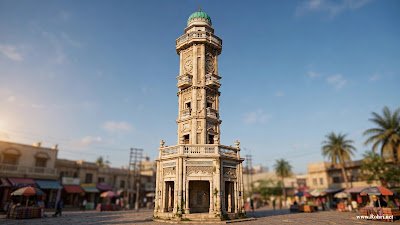
Ghanta Ghar, the clock tower on Chosul Road in central Sukkur, is the city’s most recognisable colonial-era landmark. Its formal name is the Sunderdas Dayomal Tower, and it was built in 1937 as a memorial paid for by a local merchant family. The tower stands 90 feet tall on an octagonal plan, and it has had no working clocks since all four were stolen in 1994.
This page sets out what the record shows: who paid for the tower, the two dates carved on its plaque, what happened to the clocks, and what a visit looks like today. Where a claim circulates without a source that can be checked, it is left out rather than repeated.
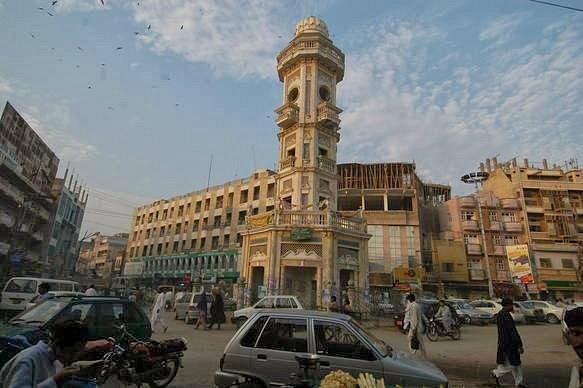 |
| Ghanta Ghar, Sukkur: the Sunderdas Dayomal Tower on Chosul Road. |
Ghanta Ghar at a Glance
Two things are usually confused about the tower: its name and its condition. The common name is a description, not a dedication, and the clock faces that give the building its purpose are gone. The essentials are these.
| Detail | What the record shows |
|---|---|
| Formal name | Sunderdas Dayomal Tower |
| Built | 1937; foundation stone 7 January, opening 30 October |
| Height | 90 feet (about 27 metres) |
| Plan | Octagonal, with rooms in the base; local accounts give the base as about 35 feet across |
| Location | Chosul Road, opposite Victoria Market, below the ridge of the Minaret of Mir Masum Shah |
| Paid for by | Seth Wadho Mal Nebhau Mal Manjhari, in memory of his brothers Seth Sunderdas and Seth Dayomal |
| Executing body | Sunder Shewak Sabha, a Sukkur social welfare organisation |
| Cost | 10,000 rupees |
| Clocks | Four; stolen in 1994; none working today |
| Heritage status | Recorded by the Endowment Fund Trust for Preservation of Heritage of Sindh (site record 14) |
Where the Tower Stands
The Ghanta Ghar occupies one of the few open corners of old Sukkur. It faces Victoria Market across Chosul Road, with the limestone ridge of the Minaret of Mir Masum Shah rising immediately behind it. That placement was deliberate: the tower stood where traffic from the surrounding quarters entered the commercial centre, so it worked as a gateway as much as a clock.
In plan it is octagonal, with functional rooms built into the lower tier and the clock stage at the top. The masonry is the dressed stone and brick typical of Upper Sindh’s colonial public buildings, materials chosen to survive a climate of extreme summer heat. Even without its clocks, the silhouette is what people navigate by: ask for Ghanta Ghar in Sukkur and no one needs a street number.
Its position is best read as a junction rather than a facade. Chosul Road runs past Victoria Market, and from the tower’s corner the old commercial streets fan out in six directions: Frere Road and Station Road towards the railway, Nishtar Road with the Shahi Bazaar, Marich Bazaar with its spice trade, and Sarafa Bazaar with its gold shops. A tower standing where six bazaars meet was doing two jobs at once, telling the time and marking the entrance to the commercial quarter.
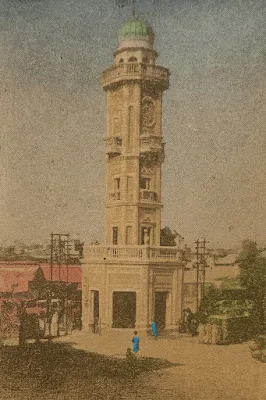 |
| The tower in 1940, three years after it opened, while the clocks were still in place. |
Who Paid for It, and Whom It Commemorates
The tower was the gift of Seth Wadho Mal Nebhau Mal Manjhari, a merchant of the Hindu trading community that dominated Sukkur’s commerce in the early twentieth century. His name appears in different transliterations across the records, including Seth Vadhumal Nebhaumal. The dedication was personal: he built the tower in memory of his brothers, Seth Sunderdas and Seth Dayomal, and their names became the building’s formal title. Variant spellings in the sources include Deo Mal and Deyomal for the second brother.
Two printed chronicles carry the same sequence of names and dates: Parasram Verumal Masand’s Sukkur Sonharo, published in 1940, and Rahimdad Khan Molai Shedai’s Tarikh-e-Sukkur of 1985. Much of the local detail used here, including the bazaar geography and the later municipal history, comes from municipal and family papers held by Sayed Imdad Hussain Shah Rizvi of Rohri (Kotai), whose oral history of the two cities is the other main source behind these pages.
Execution was entrusted to the Sunder Shewak Sabha, a Sukkur social welfare body, which appears in some records as the Sunder Shewal Sabha. The cost was 10,000 rupees, a substantial civic donation at the time. Contemporary accounts also link the project to the silver jubilee of King George V. That jubilee had been celebrated in 1935, and the king died in January 1936, so the tower marked the jubilee after both the event and the monarch had passed.
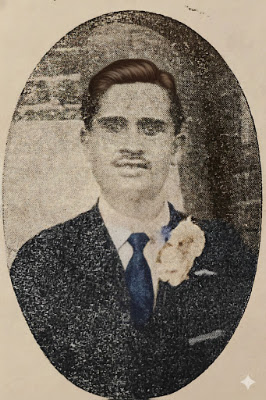
| Portrait captioned Seth Deyomal Nebhau Mal, one of the two brothers the tower commemorates. |
The Two Dates on the Plaque
A plaque on the tower records the whole sequence, and it is the closest thing to a primary document on the building. It is also the reason this page can give exact dates instead of the usual “1930s”.
7 January 1937: the foundation stone
The foundation stone was laid by D.B. Issarsing Tiloksing, President of the Sukkur Municipality, whose name is also written Issardas Tiloksingh. He was a lawyer by training and is described in local accounts as having served as a public prosecutor in Jacobabad before holding the municipal presidency.
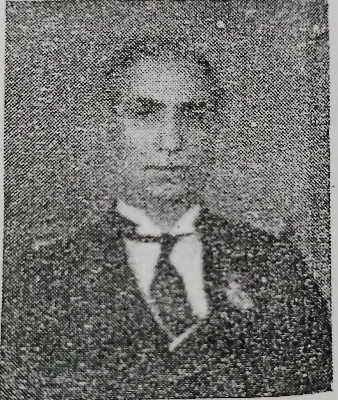 |
| Diwan Bahadur Issardas Tiloksingh, President of Sukkur Municipality, who laid the foundation stone. |
30 October 1937: the opening
The opening ceremony was performed by U.M. Mirchandani, ICS, the Collector of Sukkur, less than ten months after the foundation stone was laid. That interval explains why the tower is both “built in 1937” and “opened in 1937”: the entire structure, from stone to clock stage, belongs to a single year.
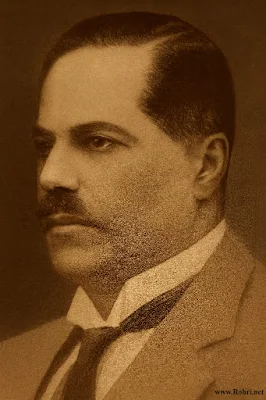 |
| Diwan Udharam Mirchandani, Collector of Sukkur, who performed the opening on 30 October 1937. |
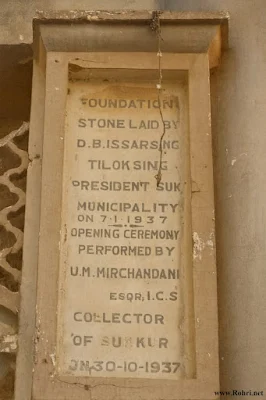 |
| The plaque recording the foundation stone of 7 January 1937 and the opening on 30 October 1937. |
The older photograph further up this page is often captioned 1940, which is the date of the photograph, not of the tower. The building was already three years old when it was taken.
What Happened to the Clocks
The tower was designed around four large clock faces, one to each side of the octagon, with chiming mechanisms that once carried across the surrounding streets. All four clocks were stolen in 1994. A police case was registered at the time, but the clocks were never recovered, and the tower has been silent since.
That loss is why descriptions of the Ghanta Ghar have changed. Before 1994 it was the city’s timekeeper; now it is an architectural landmark, valued for its outline, its stonework and its place in the street rather than for what it does. Local heritage bodies and residents have repeatedly asked for the clocks to be restored, and the Endowment Fund Trust for Preservation of Heritage of Sindh lists the building among its recorded sites.
Shops, Fences and the Changing Street
The tower’s problems were not only mechanical. In the early 1950s eight shops were built directly against its base, a common pattern in Pakistan’s old commercial centres, and for decades the lower tier was buried in shopfronts. Local accounts date the clearance of those shops to the late 1980s; the Endowment Fund Trust record gives about 2004. On either date the result is the same: the stonework was repaired and an iron fence was put around the tower to keep the space open.
What remains is a building that has been through three phases: a functioning civic clock in the colonial period, a half-hidden commercial stump after Partition, and a cleared, fenced heritage object today. The fence is the reason the octagonal base can now be seen at all.
Why the Tower Still Matters
Ghanta Ghar is one of the clearest surviving statements of pre-Partition Sukkur’s civic culture, when merchant families paid for public buildings rather than merely donating to them. The tower is a memorial, a clock, a market gateway and a piece of municipal infrastructure in one structure, which is why it outlived both the donors and the empire that granted the honour it commemorates.
For visitors it also functions as a fixed point in a city that is hard to navigate on foot. The tower, the market and the minaret above it form a compact heritage cluster: three different centuries of building within a few hundred metres. The wider story of that crossing is covered in the guide to the ancient Indus crossroads of Rohri, Bukkur and Sukkur.
Visiting Ghanta Ghar
The tower stands in the open street, so there is no ticket and no opening time: you can walk up to the fence at any hour. What you see is the exterior, since the clock stage is closed and empty. The best months are October to March, when daytime temperatures are comfortable. From May to July the city regularly exceeds 45 degrees Celsius, and the surrounding bazaars hold the heat.
Two practical notes. First, this is a working commercial street, so photograph from the pavement rather than the roadway. Second, the tower is best used as the start of a walk rather than a destination on its own: Victoria Market and the surrounding bazaars sit immediately around it, and the Minaret of Mir Masum Shah rises directly behind, with its own stair and view over the Indus. For the colonial civic context, see the history of the Commissioner’s House in Sukkur and of Sukkur’s municipal corporation.
If you are coming from Rohri, the tower is a short ride across the Indus; the Sukkur railway crossing and the Sukkur Barrage are both within reach on the same trip. The banking history of the city, including the firms that financed this kind of civic building, is covered in the banks of Sukkur.
Visitor Guide for Foreign Travellers: GPS, Arrival and What to Expect
The tower stands at 27.6944° N, 68.8642° E (27°41′40″N 68°51′51″E), on Chosul Road opposite Victoria Market in old Sukkur. Paste the pair into Google Maps or OpenStreetMap and both land on the fence around the base. Everyone in Sukkur knows the building by name, so the coordinates matter mainly for arriving on foot or for checking that a ride is heading the right way.
| For the visitor | What to expect |
|---|---|
| Coordinates | 27.6944° N, 68.8642° E |
| By air | Sukkur airport (SKZ), across the river on the Rohri side, is the nearest air link; taxis and vans meet the flights |
| By rail | Sukkur’s main station on the Karachi–Lahore line; the tower is a short rickshaw ride from the platform |
| By road | Chosul Road, in the old commercial quarter beside Victoria Market |
| Access | Free; open street at any hour; exterior only, since the clock stage is closed |
| Time needed | 20 to 30 minutes at the tower, half a day with the market and the minaret |
| Season | October to March; summer heat in Sukkur is extreme |
What a first-time visitor from abroad should know
Four practical points. First, there is nothing to buy a ticket for: the tower is a street monument, so you can arrive at any hour and leave when you like. Second, the light is best in the early morning and in the last hour before sunset, when the dome and the stonework read clearly against the sky. Third, this is a working bazaar, not a museum: photograph from the pavement rather than the roadway, ask before photographing shopkeepers, and dress as you would for any conservative market street, with shoulders and knees covered. Fourth, carry water and small notes, because the site has no facilities and rickshaw drivers rarely have change for large denominations.
Language is the one thing worth preparing in advance. Urdu and Sindhi are the working languages of the street, and English is not reliable away from hotels. Write the name down or show a photograph of the tower to a driver: the building is well known enough that a picture settles the destination faster than any pronunciation.
A half-day route around the tower
The tower works best as the first stop of a short walk rather than as a destination on its own. From the fence, cross Chosul Road into Victoria Market, then climb to the Minaret of Mir Masum Shah on the ridge behind it for the view over the Indus. The barrage and the bridges to Rohri are a short drive further on, and together they turn a twenty-minute stop into a half day of colonial and pre-colonial Sukkur.
Visitor information at a glance
| For the visitor | What to expect |
|---|---|
| Full address | Chosul Road, outside Victoria Market, central bazaar, Sukkur, Sindh 65170, Pakistan |
| Nearest landmarks | Victoria Market directly opposite; the Minaret of Mir Masum Shah about 200 metres uphill behind the tower |
| Time zone | Pakistan Standard Time, UTC+5, with no daylight saving |
| Entry | Free. No ticket office, no gate and no booking |
| Hours | The square is open at any hour; the surrounding bazaars keep roughly 09:00 to 22:00 |
| Time needed | 30 to 45 minutes at the tower; two to three hours with the market and the minaret |
| Families | Well suited to families: a flat paved square with no traffic inside the fence |
| Wheelchair access | The plaza around the fence is level and passable; the tower interior and clock stage are closed to visitors |
| Parking | Roadside and market parking on Station Road and Frere Road; motorbikes park in the bazaar lanes |
| Restrooms and water | Nothing on site. Washrooms in the market and nearby commercial buildings; bottled water sold at every corner |
| Photography | Handheld and phone photography is fine. Ask before photographing people, and drones need clearance from the district administration |
| Safety | A busy six-street junction: cross with the flow, and keep phones and wallets out of sight in the evening crowds |
| Emergencies | Police 15, Edhi ambulance 115, Chhipa 1020, Rescue 1122 |
Weather and the best months
Winter, roughly November to February, is mild and dry, with nights that can fall to about 5°C and afternoons around 24°C; occasional morning fog sits along the Indus. Summer, April to September, is dry subtropical heat that regularly passes 40°C and can reach 45°C, so the tower is best seen before nine in the morning or after sunset. The monsoon of July and August brings little rain, about 60 mm in the year, but the showers that do come can flood the legacy lanes of the bazaar for an hour or two. October to March is the window most visitors should aim for, and a forecast is worth checking before setting out in summer.
Food, beds and money
The bazaar around the tower is a food district in its own right: chicken chargha, seekh kabab, tikka, dahi baray, gol gappay and fried Indus palla, with the stalls along Frere Road busiest after sunset. Mid-range hotels and guest houses cluster on Station Road and near the bypass a few kilometres out, and the winter season is worth booking ahead for. Money is the Pakistani rupee, and cash is what the bazaar, the rickshaws and the food stalls run on, though the larger hotels take cards; ATMs of the main banks stand on Station Road within a short walk of the tower.
Language and connectivity
Sindhi and Urdu are the working languages of the street; English is usual in hotels and among the shopkeepers who deal with visitors. Mobile coverage is good, with 4G on Jazz, Zong, Telenor and Ufone reaching the bazaar, so a local SIM is the cheapest way to stay online.
What is within reach
| Radius | What is there |
|---|---|
| Within 1 km, on foot | Victoria Market opposite; the Minaret of Mir Masum Shah about 200 metres uphill; the old Civil Hospital and Ghous Ali Shah Dispensary of 1859 on the Chhapri slope; the lanes of Chhapri Otaro |
| Within 5 km | The Lansdowne Bridge of 1889 and the Ayub Bridge of 1962; Sadh Belo island temple; the Deputy Commissioner’s office of 1901 and Tekchand Bolchand Park of 1934 on Bunder Road; the waterworks of 1895 |
| Within 25 km | The Sukkur Barrage and its colony; Satyn-jo-Than across the Indus at Rohri; the mounds of ancient Aror, capital of Sindh before 712; Kot Diji fort on the N-5 |
Arriving from outside the city
| Starting point | Distance and time |
|---|---|
| Sukkur airport (SKZ) | About 8 km, 15 to 20 minutes by road; taxis and ride-hailing cars meet the flights |
| Sukkur railway station | About 1.5 km, five minutes by rickshaw, on the Karachi to Lahore main line |
| Rohri junction | About 7 km across the Lansdowne and Ayub bridges, 15 to 20 minutes |
| Intercity bus terminal | About 4 to 5 km on the bypass, 10 to 15 minutes by rickshaw or taxi |
Visitor checklist
- Walking shoes that will survive broken paving and a wet bazaar lane.
- A charged phone or camera: the tower is the most photographed building in the old city.
- Small notes for rickshaws, tea and street food, because change is scarce.
- Sun protection for any visit between ten and four.
- Modest clothing, with shoulders and knees covered, for the market streets.
At the minaret and the shrines within reach, the usual courtesy applies: shoes off where others have left theirs, no photographing worshippers without asking, and a scarf for women at the shrine of Sadar-ud-din Shah. The Ghanta Ghar itself has no religious function, so the rules that matter there are street rules: keep to the pavement, ask before a portrait, and dress for a conservative market.
Timeline
| Date | What happened |
|---|---|
| 7 January 1937 | Foundation stone laid by Diwan Bahadur Issardas Tiloksingh, President of the Sukkur Municipal Board, for a tower paid for by Seth Wadho Mal Nebhau Mal Manjhari in memory of his brothers. |
| 30 October 1937 | Opened by U. M. Mirchandani, ICS, Collector of Sukkur, less than ten months later, at a cost of 10,000 rupees. |
| Early 1950s | Eight shops are built against the base of the tower, burying the lower tier. |
| 1994 | All four mechanical clocks are stolen; a police case is registered but the clocks are never recovered. |
| Late 1980s, or about 2004 | The shops are cleared and an iron fence is put around the base. Local accounts date the clearance to the late 1980s, the Endowment Fund Trust record to about 2004. |
| Today | Free-standing landmark at the junction of the old bazaars, recorded by the Endowment Fund Trust as site 14. |
Sources and Further Reading
- Endowment Fund Trust for Preservation of Heritage of Sindh: Ganta Ghar Clock Tower, Sukkur, site record 14, for the 1937 date, the donors, the cost and the height.
- Endowment Fund Trust: Ghanta Ghar, Sukkur district record, for the 1950s shops, the clearance around 2004, the iron fence and the loss of the clocks.
- Clock Tower, Sukkur, for the 90-foot height, the 1937 inauguration and the 1994 theft, used here as a pointer to the underlying records.
- The Express Tribune, “At 79 years, Sukkur’s Ghanta Ghar begs for govt attention”, 7 January 2016, for the police case and the failure to recover the clocks.
- The plaque photograph on this page, which records the foundation stone of 7 January 1937 and the opening of 30 October 1937.
- Sukkur.net: Ghanta Ghar, the Sunderdas Dayomal Tower, for the plaque transcription and the officers named on it.
- Sayed Imdad Hussain Shah Rizvi of Rohri (Kotai), municipal and family papers and oral history, consulted for the names, dates and bazaar geography used here.
- Parasram Verumal Masand, Sukkur Sonharo (Sukkur, 1940), and Rahimdad Khan Molai Shedai, Tarikh-e-Sukkur (Jamshoro, 1985), the two printed chronicles that carry the same sequence.
- Muhammad Siddique G. Memon, Sukkur Then and Now (2000), for the later civic history.
- Government of Bombay, Gazetteer of the Province of Sind, Volume III: Sukkur District (Bombay, 1907), for the municipal background before 1937.
This article was reviewed on 7 November 2026 against the sources listed above. Dates and names that could not be checked against a record are marked as variants rather than repeated as certainties.
Frequently Asked Questions
When was Ghanta Ghar Sukkur built?
The foundation stone was laid on 7 January 1937 and the tower was opened on 30 October 1937, so the whole building belongs to a single year. The date 1940 sometimes attached to photographs is the date of the photograph, not of the tower.
Who built Ghanta Ghar and why?
Seth Wadho Mal Nebhau Mal Manjhari, a Sukkur merchant, paid for the tower at a cost of 10,000 rupees in memory of his brothers, Seth Sunderdas and Seth Dayomal. The work was carried out by the Sunder Shewak Sabha, and the building took their names as its formal title.
Is the Ghanta Ghar the same building as the Sunderdas Dayomal Tower?
Yes. Sunderdas Dayomal Tower is the formal name, taken from the brothers the building commemorates. Ghanta Ghar is the everyday name, from the Hindi and Urdu words for a bell or hour and a house, meaning clock tower.
How tall is the Ghanta Ghar and what shape is it?
The tower is 90 feet high, roughly 27 metres, and octagonal in plan. It has functional rooms in the lower tier and the clock stage at the top. Local accounts give the base as about 35 feet across.
What happened to the clocks on Sukkur’s clock tower?
All four clocks were stolen in 1994. A police case was registered but the clocks were not recovered, so the tower has no working timepiece. The clock faces and mechanism have been empty since then.
Do I need a ticket to visit the Ghanta Ghar?
No. The tower stands in the open street opposite Victoria Market on Chosul Road, so there is no ticket and no opening hours. Visitors see the exterior; the clock stage is closed and empty.
Why is the tower important to Sukkur?
It is one of the best surviving examples of pre-Partition civic philanthropy in Upper Sindh, paid for by a merchant family and run by a local welfare body. It also remains the practical centre of the old commercial quarter, next to Victoria Market and below the Minaret of Mir Masum Shah.
Where is Ghanta Ghar Sukkur located?
On Chosul Road in old Sukkur, opposite Victoria Market and below the Minaret of Mir Masum Shah, at 27.6944° N, 68.8642° E. The tower stands in the open street, so there is no gate, no ticket and no closing time; visitors see the exterior, and the clock stage is closed.
Conclusion
The Ghanta Ghar is a memorial first and a clock tower second: built in 1937 for two brothers, opened the same year, and silenced in 1994. Its plaque gives the dates, its octagon gives the shape, and its empty clock stage explains why the building is described today as a tower rather than a timekeeper.
Walking from Victoria Market past the fence and looking up at the ridge behind it shows three centuries of Sukkur in one view. That is the reason to stop, and the reason the building is still worth arguing about.
Post: Sayed Sajjad Hussain Musavi – Rohri.net, the heritage archive of Rohri and Sukkur
Frequently Asked Questions
Where is Ghanta Ghar Sukkur located?
On Chosul Road in old Sukkur, opposite Victoria Market and below the Minaret of Mir Masum Shah, at 27.6944 N, 68.8642 E. The tower stands in the open street, so there is no gate, no ticket and no closing time.
When was Ghanta Ghar Sukkur built?
The foundation stone was laid on 7 January 1937 and the tower was opened on 30 October 1937, so the whole building belongs to a single year. The date 1940 sometimes attached to photographs is the date of the photograph, not of the tower.
Who built Ghanta Ghar and why?
Seth Wadho Mal Nebhau Mal Manjhari, a Sukkur merchant, paid for the tower at a cost of 10,000 rupees in memory of his brothers, Seth Sunderdas and Seth Dayomal. The work was carried out by the Sunder Shewak Sabha, and the building took their names as its formal title.
Is the Ghanta Ghar the same building as the Sunderdas Dayomal Tower?
Yes. Sunderdas Dayomal Tower is the formal name, taken from the brothers the building commemorates. Ghanta Ghar is the everyday name, from the Hindi and Urdu words for a bell or hour and a house, meaning clock tower.
How tall is the Ghanta Ghar and what shape is it?
The tower is 90 feet high, roughly 27 metres, and octagonal in plan. It has functional rooms in the lower tier and the clock stage at the top. Local accounts give the base as about 35 feet across.
What happened to the clocks on Sukkur’s clock tower?
All four clocks were stolen in 1994. A police case was registered but the clocks were not recovered, so the tower has no working timepiece. The clock faces and mechanism have been empty since then.
Do I need a ticket to visit the Ghanta Ghar?
No. The tower stands in the open street opposite Victoria Market on Chosul Road, so there is no ticket and no opening hours. Visitors see the exterior; the clock stage is closed and empty.
Why is the tower important to Sukkur?
It is one of the best surviving examples of pre-Partition civic philanthropy in Upper Sindh, paid for by a merchant family and run by a local welfare body. It also remains the practical centre of the old commercial quarter, next to Victoria Market and below the Minaret of Mir Masum Shah.

[…] more: Ghanta Ghar Sukkur · 15 Best Places to Visit in Sukkur and […]
[…] areas were affected at the same time. In central Sukkur, Station Road, the area around the historic Ghanta Ghar clock tower, Hussain Road and other main business districts stood underwater, halting trade and cutting […]